Why Wedding Timelines Slip 45 Minutes — and What Holds Them
Why Wedding Timelines Slip 45 Minutes — and What Actually Holds Them TogetherPhotograph enough weddings and you stop being surprised by the slip. By 5 PM most wedding days are running 30 to 45 minutes behind the printed timeline. The bouquet toss happens during what was supposed to be cake cutting. The grand exit gets compressed into seven hurried minutes because the venue's contracted end time has not moved. Couples blame the day. Vendors blame each other. Almost nobody blames the document, even though the document is usually where the failure starts. This is for planners, coordinators, and couples who want to understand the mechanics — and what is actually holding successful timelines together in 2026. Disclosure: I built EventSync, the app I mention later in this post. After years of photographing weddings and watching the same three coordination failures play out, I started building the tool I wished existed. Everything here comes from real weddings I have shot. The 45-minute slip in plain terms
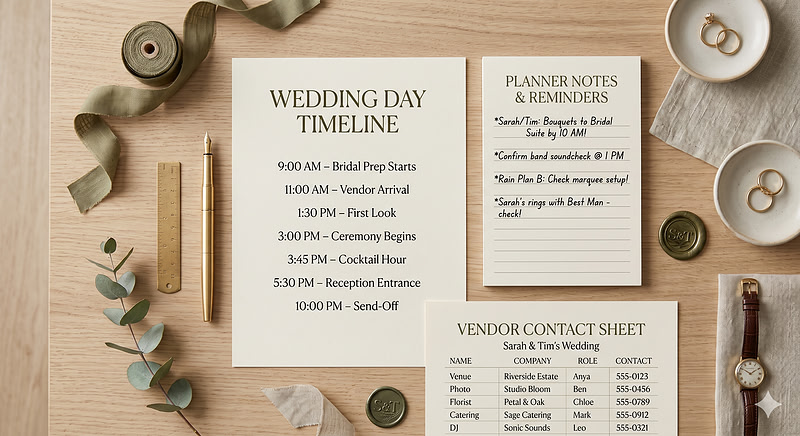
Three predictable failure points1. Dependency invisibilityA wedding day is not a list. It is a graph. First-look depends on hair finishing. Bridal portraits depend on first-look. Family portraits depend on bridal. Cocktail staging depends on portraits clearing. The grand entrance depends on cocktail hour ending on time. When the timeline lives in a Word doc or printed PDF, the dependencies are invisible. Every block looks independent. So when hair runs 22 minutes late, nobody sees that they have just consumed the buffer for five downstream blocks, not one. Use the free Wedding Day Timeline Builder to turn the day into an interactive run-of-show with protected anchors, flexible blocks, and real buffers.
When a delay needs a response, keep the free Running Behind Recovery Card with the person watching the clock so they can protect anchors, spend buffer, compress flexible blocks, and move what can move. 2. Vendor channel fragmentationThe photographer is on a Google Doc. The florist confirmed by email. The DJ is texting the maid of honor. The officiant has the address but not the rehearsal time. The caterer's load-in window was set six weeks ago and never re-confirmed. When something changes the morning of, and on a typical wedding three to five things change the morning of, there is no single channel. Updates go out to whoever the couple happens to think of. The vendors who do not get the update show up at the original time.
3. Decision-rights ambiguityBy 4 PM the planner has been on her feet for eight hours. The venue coordinator's shift technically ended an hour ago. The maid of honor is now answering vendor questions because she happens to be standing closest to the kitchen door. Decisions are still being made, but by people without context, and the couple is being pulled in to settle questions that should have been resolved during planning.
Time note. Hair running 18 minutes late is normal. Every experienced planner builds a buffer for it. The actual failure is what happens to the next nine blocks after the buffer is consumed. The tool I built — and now use on every weddingI am a wedding photographer first. The reason I started building EventSync — a planner and day-of coordinator app — was that I was tired of watching wedding mornings unravel for the same three reasons every season. Plan the wedding. Run the day.
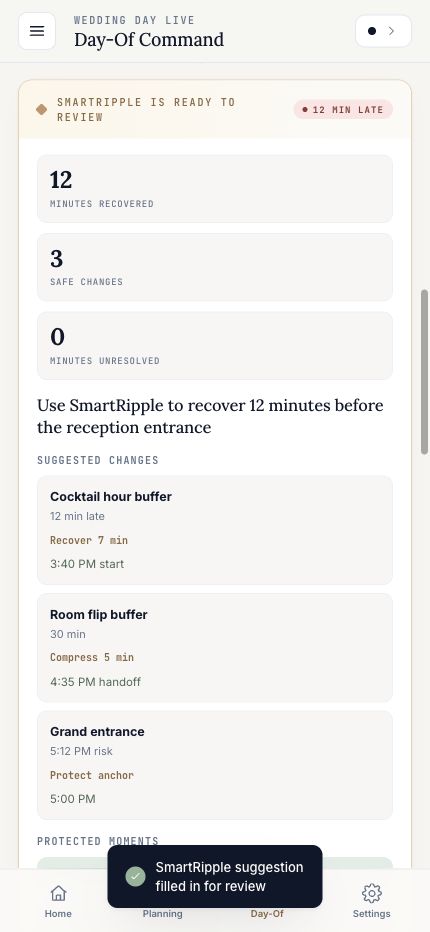
Why I built this A planner + day-of coordinator app that models dependencies correctly. Smart Ripple is the model I built EventSync around — wedding-day dependencies handled the way they actually work. For planners and serious couples. Try the Smart Ripple demo →A 90-second testThe fastest way to see whether the dependency model is real is to try it. Drag a block on the demo. Watch the rest of the timeline recalculate. If you have ever rebuilt a wedding-day timeline by hand at 6 AM the morning of, this is the demo to try. If you are planning without a plannerYou can run a calm wedding without hiring a planner, but you cannot run a calm wedding without a system. The default setup, a printed timeline plus a group text, is the same setup that produces the 45-minute slip.
For the planners reading thisIf you have been managing weddings in a combination of Aisle Planner, Honeybook, a Google Sheet, and three group texts, you already know where the cracks are. Your judgment is the irreplaceable part of what you do. The recompute and the re-broadcast are not. Hand those off. Questions about timing with your ceremony, portraits, or vendor coordination. Contact me and I will help you plan the sequence. |